
Singapore’s landed home market closed 2025 with its strongest performance in four years. According to URA’s Q4 2025 real estate statistics, 1,852 landed homes were sold across the year — the highest annual volume since 2021, up 11.2% year-on-year. Q4 alone recorded 491 transactions, the busiest landed quarter since Q2 2022. Prices rose 7.6% across the full year, with Q4 contributing a 3.5% quarter-on-quarter surge — the largest single-quarter gain in two years.
On the surface, this looks like a straightforward upcycle. But look at who is buying, where the transactions are happening, and what macro forces are at play, and a more nuanced picture emerges. The buyer base has shifted. The geographic centre of gravity has moved. And for the first time in years, the interest rate environment is cooperating with buyers rather than working against them.
The Buyer Profile Has Changed
The most revealing trend in ERA’s quarterly landed research is not the volume or the price index — it is who is actually buying. In 2023, HDB owners accounted for 16% of landed home purchases. In 2024, that share fell to 14%. By 2025, it had dropped to just 11%. The decline is consistent and directionally clear: HDB upgraders are retreating from the landed segment, replaced by a different buyer entirely.
The gap between typical HDB resale exit equity and the entry cost of a landed home has widened faster than most HDB households can bridge. The capital needed to reach even an entry-level OCR terrace — typically in excess of $2 million — requires an equity stack that most HDB sellers cannot assemble without an intermediate private property step.
The buyer filling that gap is the condominium upgrader: someone who bought a private condo several years ago, has seen meaningful price appreciation on that asset, and is now converting non-landed equity into landed ownership. This cohort has larger deposit pools, less CPF dependency, and more flexibility on timing and structure. The $2.5M to $5M price bracket — which accounted for 52.4% of all landed sales in Q2 2025, per ERA data — sits squarely within the reach of this profile.
The implications extend beyond demographics. As the market becomes more self-contained — buyers cycling within private property rather than bridging from public housing — the pool of natural sellers also compresses. Condo upgraders buying landed are typically buying for the long term, not as a stepping stone. This quietly tightens available supply from within.
Falling Interest Rates Are Reshaping the Math

For much of 2023 and into 2024, rising borrowing costs acted as a meaningful brake on the landed segment. A buyer taking out a $2M mortgage at a rate above 3.5% faces a very different monthly commitment from one borrowing at 2%. The shift in SORA over the past year has materially altered that equation.
The 3-month Compounded SORA — Singapore’s primary floating rate benchmark for home loans — fell from 3.02% in March 2025 to approximately 1.19% by January 2026, a drop of nearly 1.8 percentage points in under a year. Fixed-rate mortgage packages, which were priced well above 3% at their peak, had come down to a range of 1.55% to 2.40% by November 2025.
For a buyer financing $2 million over 25 years, a rate reduction of 1.5 percentage points translates to roughly $1,500 to $2,000 lower in monthly repayments. On a segment where buyers are already stretching to reach a multi-million dollar commitment, this is not a marginal difference. It is the difference between a transaction that is financially comfortable and one that requires sustained sacrifice.
OrangeTee noted in their 2025 review that as rates continue to moderate, high-net-worth buyers seeking capital preservation are expected to remain active in the luxury landed segment — with appetite projected to continue into 2026. ERA made a similar observation, citing the low-interest environment alongside Singapore’s GDP growth as dual tailwinds that have directly supported homebuying confidence.
The OCR Has Become the Market’s Engine Room
The landed segment’s volume story in 2025 was, geographically, an Outside Central Region story. In Q4 2025, OCR landed transactions rose 12.4% quarter-on-quarter. The Rest of Central Region added 5.4%. The Core Central Region, meanwhile, recorded fewer deals — not because demand for prime landed homes has collapsed, but because buyer and seller price expectations in that tier have drifted further apart.
Terrace houses drove the OCR volume. They accounted for 57.2% of OCR landed transactions, and more than half of all landed deals across Singapore in Q4 2025. This is the ‘entry point’ product — the first landed home a condo upgrader realistically targets — and its concentration in the suburbs reflects where the bulk of landed affordability still sits.
In the OCR, suburban landed homes in areas like Woodlands, Sengkang, and Jurong corridors have maintained entry PSF levels that remain more accessible than central locations. For buyers who prioritise land area, garden space, and the practical realities of multigenerational living or a dedicated home office, the OCR terrace delivers on those requirements at a price that the RCR or CCR cannot match.
The CCR market is a different story. Sellers in prime landed areas — particularly those holding good-class bungalows or large detached homes — have raised asking prices in line with their own assets’ appreciation, creating a standoff with buyers unwilling to close the gap. Transaction volumes are lower, but this should not be read as weakness. It reflects seller confidence and the illiquidity that characterises the ultra-premium segment in any cycle.
There Is Not Enough to Buy
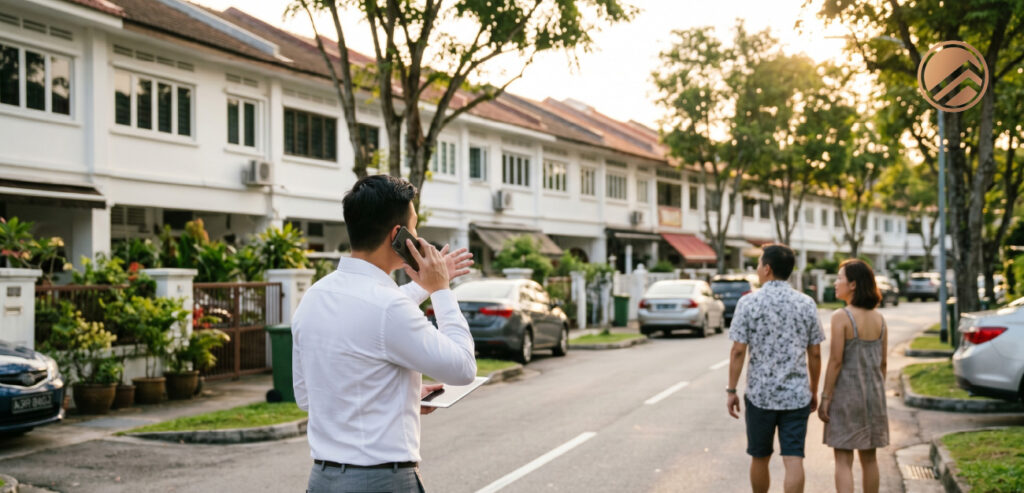
One of the least-discussed dynamics in the current landed market is the thinness of resale inventory. Property agents have consistently noted across 2025 that sellers are hesitant to list — not because their homes have lost value, but because the replacement problem has become acute. If you sell your landed home at today’s prices, you face buying back into a market where every equivalent property has also appreciated. The net gain from the sale is partially eroded by the higher cost of your next purchase.
This creates a self-reinforcing loop. Lower resale supply puts upward pressure on prices. Higher prices make sellers more reluctant to transact. Which keeps supply low. The structural foundation of this dynamic — roughly 73,000 landed homes total in Singapore against approximately 500,000 condominium units — means the base supply is already inelastic. Seller reluctance makes it more so.
For buyers watching the market in 2026, this is a material consideration. Waiting for inventory to improve assumes that sellers will find compelling reasons to list — and in the current environment, those reasons are not obvious. The more likely scenario, particularly in the OCR terrace segment, is continued competition for a limited pool of properties, with the price level set by whoever is willing to transact rather than whoever is waiting.
What 2026 Looks Like From Here
ERA’s baseline forecast for 2026 projects 1,750 to 1,950 landed transactions and full-year price growth of 5% to 7% — assuming current momentum holds. Heading into Q1 2026, the market has recorded four consecutive quarters of price growth since Q4 2024. The structural drivers — tight supply, condo upgrader demand, falling borrowing costs, and the inelastic nature of landed stock — remain intact.
The tailwinds are real. But so are the headwinds. Singapore’s GDP growth is forecast at 2.2% in 2026 — a stable but not expansionary backdrop. Global macro uncertainty, including the impact of US trade policy on regional sentiment, introduces a risk factor that is difficult to model. And at current price levels, affordability is not unlimited: the $2.5M to $5M bracket that has been driving volume has a ceiling shaped by the equity profiles of the buyers within it.
The segment most likely to remain active across scenarios is the OCR terrace — the most accessible entry point, serving the widest buyer profile, and benefiting most directly from rate moderation. The luxury end — GCBs, large detached bungalows in prime zones — will remain supported by wealth preservation demand, but transaction volumes will be low by design. Any significant reversal in SORA would also reshape the affordability calculus that has supported current momentum.
The Bigger Picture
Singapore’s landed home market in 2025 was not simply a market that rose in price and volume. It was a market that told a story about who has the capital, the confidence, and the right financial timing to reach it. That cohort is increasingly defined by private property equity rather than public housing savings — and they are buying in the suburbs, in the $2.5M to $5M range, with mortgages that cost meaningfully less to service than they did eighteen months ago.
The supply side of this equation has not changed. There are approximately 73,000 landed homes in Singapore. That number will not grow in any meaningful way. As the wealth base expands and condo upgraders accumulate the equity needed to make the move, more buyers will chase the same fixed inventory — and the structural price support that has defined this segment for decades will continue to do so.
The landed market of 2026 will likely look much like the one that closed out 2025: active in the suburbs, constrained by inventory, driven by a narrower but wealthier buyer base, and supported by a rate environment that — for now — is working in buyers’ favour. That combination does not guarantee price growth. But it does explain why the structural case for landed, as a long-term residential asset in a land-scarce city, remains as intact as it has ever been.
If you are considering making the move into the landed segment, our expert sales consultants are on hand to guide you through your options — from identifying the right property type and location to navigating the financial and eligibility requirements. Reach out to start the conversation.