
Singapore’s landed property market posted its strongest year since 2021 in 2025 — 1,852 transactions, 7.6% full-year price appreciation, and the busiest quarter since mid-2022. The headlines wrote themselves. But the story behind the numbers is more interesting than the numbers themselves.
The buyer driving this recovery is not who most people picture when they think of Singapore’s landed market. The HDB owner who saved for years and stretched to afford a terrace house is becoming a smaller part of the picture with every passing quarter. In their place, a quieter and considerably better-resourced cohort has taken centre stage: the private condominium owner, sitting on years of accumulated equity and finally ready to make their move.
Understanding who this buyer is, where their buying power came from, and what their dominance means for the market going forward tells you more about Singapore’s property landscape in 2026 than any set of transaction statistics.
The Old Playbook Is Breaking Down
For much of the last two decades, HDB upgraders were a significant and consistent source of demand in the landed market — at their peak in the early 2010s, they accounted for roughly one in four landed transactions. The arc was familiar: buy a BTO flat, wait out the five-year Minimum Occupation Period, sell into a buoyant resale market, pocket the proceeds, and use them as a down payment on an entry-level terrace in the Outside Central Region.
That pathway is closing. HDB upgraders accounted for 16% of landed purchases in 2023. By 2024, the share had slipped to 14%. In 2025, it fell again to 11%.
The decline is not about intent — HDB owners are not losing interest in landed property. It is about mathematics. Singapore’s HDB resale market performed strongly over the early 2020s, with prices rising 12.7% in 2021 and 10.4% in 2022. But landed property prices were keeping pace — and from a much higher starting point. Entry-level terraces in accessible OCR corridors crossed the $2 million mark and kept climbing. The typical HDB resale proceeds, even after a strong sale, cannot bridge a gap that has widened on both sides.
When an HDB seller nets $500,000 to $700,000 from their flat, they are looking at a landed entry price that starts at $2 million and trends upward. Even with CPF housing grants and favourable borrowing conditions, the loan required to bridge that gap would test most buyers’ Total Debt Servicing Ratio limits. This is not a cyclical speed bump. It is a structural recalibration — and one that is unlikely to reverse in the near term.
Where the Buying Power Came From
While the HDB upgrader’s window has narrowed, a different group found theirs opening. Between 2020 and 2023, Singapore’s private residential property prices rose by approximately 31% cumulatively — 2.2% in 2020, 10.6% in 2021, 8.6% in 2022, and 6.8% in 2023. Condominium owners who bought before or during the pandemic found themselves sitting on substantial unrealised gains.
A buyer who purchased a non-landed private property at $1.2 million in 2019 might conservatively value the same unit at $1.6 million to $1.8 million by 2024. That differential — $400,000 to $600,000 in paper gains — is a meaningful down payment on a $3 million OCR terrace. Combined with cash savings and CPF balances accumulated over the same period, many of these owners suddenly had the financial architecture to make the leap.
The final piece was timing. Borrowing costs peaked across 2022 to 2023, with 3-month SORA reaching 3.02% by early 2025. As the rate environment shifted — SORA falling to approximately 1.19% by January 2026 and fixed-rate mortgage packages dropping to the 1.55% to 2.40% range — monthly financing costs on a $2 million loan fell by an estimated $1,500 to $2,000. That reduction made upgrading from condo to landed financially viable for buyers who had the equity but not the appetite for peak-rate servicing costs.
The 2025 landed market surge did not come from nowhere. It was the downstream effect of a private property bull run that lasted from 2020 to 2023 — arriving with a two-to-three year lag, which is about how long it typically takes a homeowner to move from contemplation to transaction.
Who Is This Buyer?
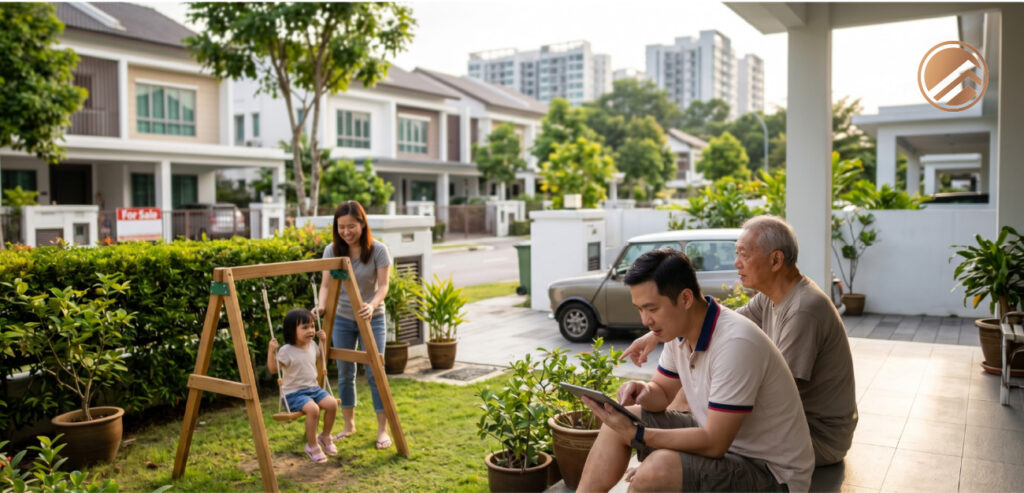
The condo upgrader moving into landed is not a monolith, but a recognisable profile has emerged. They are typically in their late thirties to early fifties, purchasing with a spouse or partner, and motivated almost entirely by family considerations: more space for growing children, room for ageing parents, a garden, and a sense of permanence that a high-rise unit cannot offer.
What distinguishes them financially from the HDB upgraders of previous cycles is their relationship with debt. Having already bought and sold at least one private property, this cohort tends to arrive with a larger deposit pool, reduced dependence on CPF, and a shorter loan tenor — all of which translate to a more comfortable debt serviceability profile.
Critically, they are not buying as a stepping stone. The condo upgrader who reaches landed tends to plan on staying. This is a home for the next fifteen to twenty years, possibly a property to pass on to the next generation. That intent has structural consequences — which leads to the dynamic that matters most about this shift.
What They’re Buying, and Where
The OCR terrace is the dominant vehicle for this cohort. Woodlands, Sengkang, Jurong, and similar suburban corridors offer the most accessible entry points into the landed segment, and it is here that the condo upgrader’s equity finds its best match.
The $2.5 million to $5 million price bracket accounted for 52.4% of all landed transactions in Q2 2025 — the clearest signal of where the market’s centre of gravity sits. OCR landed transactions surged 12.4% quarter-on-quarter in Q4 2025, with terrace houses representing more than 57% of those deals. These are not premium addresses. They are practical, family-oriented purchases in mature or maturing estates with good school catchments and MRT connectivity — exactly what a buyer in their forties prioritises.
The Core Central Region tells a different story. Pricing there remains elevated, and sellers are confident enough to hold their asks. But buyers at the $8 million-plus tier are fewer, and the value proposition of a CCR terrace versus other luxury asset classes is less straightforward. The volume, for now, is firmly in the suburbs.
The Self-Reinforcing Cycle
Here is the dynamic that receives the least attention in most market commentary, and arguably matters most.
When condo owners sell their units to purchase landed homes, they release supply into the non-landed private residential market. More condo units available means more choice — and potentially better pricing — for buyers looking to enter the private market from HDB. That part is straightforward.
The less obvious side of the equation is what happens to the landed units they buy. This cohort’s intention is overwhelmingly to hold. They are not traders. They are not buying to sell in five years. When a buyer purchases a terrace house as a generational home, that property is effectively removed from the transactable market for a decade or more.
Singapore’s landed residential stock sits at approximately 73,000 homes — a figure that has remained largely fixed for years due to the scarcity of developable land and strict limits on new landed development. There are no large new landed housing estates in the pipeline. The supply base is structurally inelastic.
When long-term holders dominate an inelastic supply base, the transactable pool shrinks from within — even as overall ownership numbers remain stable. Transaction volumes may fluctuate with economic conditions, but the structural floor under landed prices is reinforced every time a condo upgrader decides their terrace is the last property they intend to buy.
What This Means for You
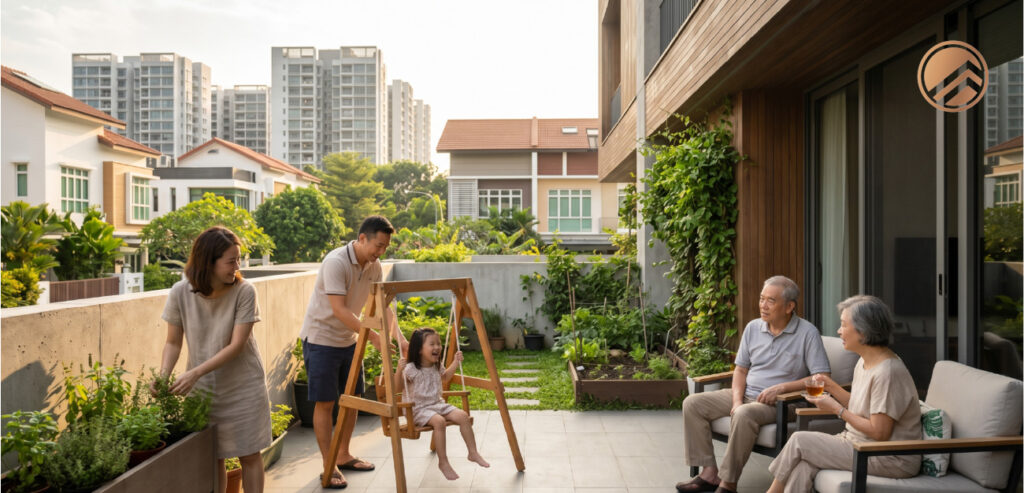
Three groups are watching this market from different vantage points, and the implications for each are distinct.
For condo owners considering an upgrade, conditions in 2025 and into 2026 represent a more favourable window than the rate-peak years of 2022 and 2023. If your equity position and monthly serviceability align — and your unit has appreciated meaningfully since purchase — the structural argument for entering the landed segment sooner rather than later is credible. OCR terraces in the most accessible corridors have already moved significantly; patience may not be rewarded the way it was five years ago.
For HDB owners watching from the sidelines, the HDB-to-landed gap is unlikely to narrow in the near term. The more actionable question may be whether to look at the condo market instead. As upgraders list their units to fund landed purchases, non-landed private supply in certain districts may increase. The $1.2 million to $1.8 million segment — entry-level private property — could see more choice and more negotiable pricing as that supply enters the market.
For existing landed homeowners, the structural forces described above are working in your favour. Replacement-cost logic keeps sellers reluctant to list, demand from a financially capable and long-term-oriented buyer cohort continues to grow, and the supply base is not getting any larger. None of this requires action. It simply means the asset you hold is being supported by forces that operate independently of any single quarter’s transaction data.
The Bigger Picture
Singapore’s property ladder was once a more linear progression — HDB to condo to landed, with each rung reachable from the one below given enough time and discipline. That linearity is giving way to something more stratified. The condo-to-landed pathway remains open, but it is open primarily to those who entered private property early enough to accumulate equity through the 2020–2023 bull run. The HDB-to-landed pathway is becoming the exception rather than the rule.
What is emerging is a landed market that increasingly self-selects for wealth already inside the private residential system — recycling and concentrating equity rather than drawing it up from the public housing base. For a city-state where land is the ultimate finite resource, that dynamic is worth watching closely — whether you are a buyer deciding your next move, or simply trying to understand where the market is heading and why.
If you’re weighing up the move from condo to landed and want to understand what your options look like today, speak to a property consultant who can walk you through the numbers.