
For many buyers exploring Singapore’s landed property market, the first question often sounds straightforward: Which district should I buy in?
But the reality is more nuanced. The better question is often which type of landed home — and which district — actually fits your life stage, financial position and long term goals.
Across Singapore’s eastern landed districts, the hierarchy has become increasingly clear over the past decade. District 15 has emerged as the premium address, commanding higher price per square foot across detached, semi-detached and terrace homes. District 14 typically follows as the closest substitute, while District 16 functions as the value alternative for buyers seeking landed living at a lower entry price.
Yet this does not mean every buyer should automatically choose District 15. The right decision often depends on the buyer’s priorities: lifestyle, family needs, land size, liquidity and long term holding plans.
To better understand how different buyers might approach the market today, let us walk through three realistic scenarios. Each reflects a common profile we see among landed home buyers in Singapore and illustrates how the “right” decision can differ depending on circumstances.
Scenario One: The Young Upgrader Family
Profile
Daniel and Rachel are both in their late thirties. With two young children and stable careers in finance and healthcare, their combined income is around $22,000 a month. They currently live in a condominium in the East but are increasingly drawn to the idea of landed living.
Their priorities are fairly typical for this stage of life:
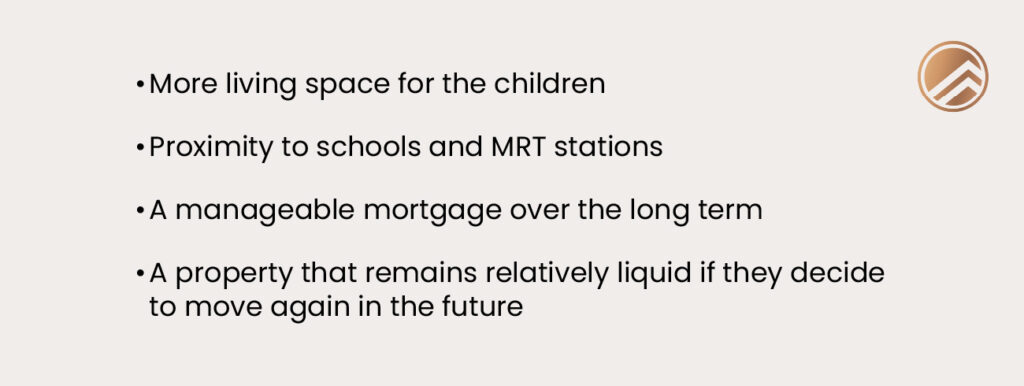
Their comfortable budget sits around $5.5 million to $7 million, placing them squarely in the range of many terrace houses in the eastern districts.
Understanding the Market Reality
When looking at the landed market in District 15, one important observation stands out: terrace homes form the most liquid segment.
Transaction data for 2025 shows:

This tells us something important about buyer behaviour. Terrace homes represent the broadest entry point into landed living, meaning they tend to transact more frequently and provide clearer price discovery in the market.
In practical terms, this means terrace houses often provide stronger liquidity and a larger pool of potential buyers compared to other landed types.
The Options They Consider
With their budget and priorities in mind, Daniel and Rachel shortlist three possible options:
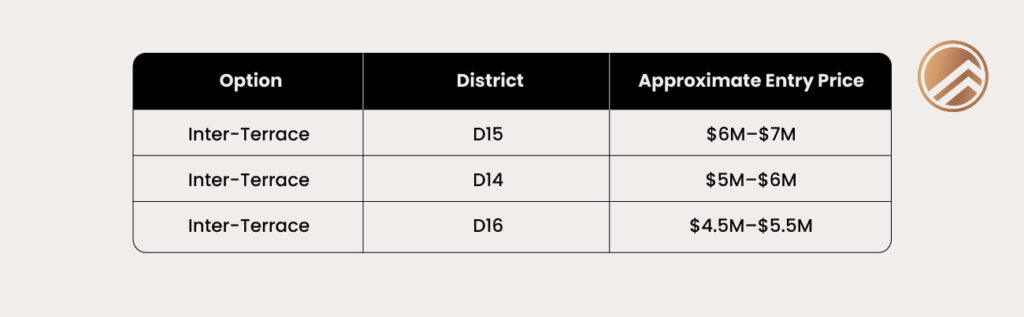
Each option offers a slightly different balance between price, address and long term value.
District 16 offers the lowest entry price, which means a more comfortable mortgage. District 14 provides a middle ground. District 15 commands the highest prices, but also carries the strongest address premium.
The Final Choice
In this scenario, Daniel and Rachel ultimately choose an inter-terrace house in District 15.
The decision comes down to a few key considerations.
First, District 15 consistently commands the highest median price per square foot across landed segments, reflecting sustained buyer demand for the address.
Second, the East Coast lifestyle — with proximity to the beach, strong amenities and established landed enclaves — continues to attract families looking for long term homes.
The trade off, of course, is land size. Terrace homes in District 15 tend to sit on smaller plots compared to those in neighbouring districts, yet still command higher prices. This suggests buyers are willing to pay a premium for the location rather than purely for land quantum.
For Daniel and Rachel, the decision is simple:
They are paying for the address, knowing it remains one of the most sought after landed locations in Singapore.
Scenario Two: The Multi Generational Household
Profile
Andrew and Mei Ling are in their mid forties. Their children are entering secondary school, and they are beginning to think about bringing Andrew’s elderly parents to live with them.
Their priorities are different from Daniel and Rachel’s:
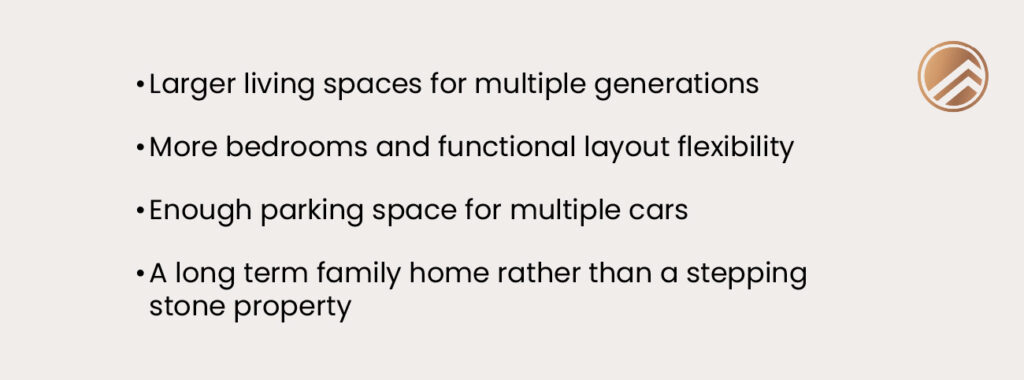
Their budget sits around $8 million to $9 million, putting them in the range of semi-detached homes.
Market Reality in the Semi Detached Segment
Semi-detached homes occupy an interesting position in the landed market.
They offer significantly more space than terrace houses, yet remain far more attainable than detached homes. However, the segment also shows a particular pattern: a large concentration of listings within a relatively narrow price band.
In District 15, the bulk of semi-detached listings sit between $8 million and $9 million, with further listings extending toward $11 million.
This clustering suggests intense competition within the segment. When many similar homes are available within the same price range, buyers often gain stronger negotiating leverage.
Liquidity is also lower compared to terraces. In 2025, semi-detached homes recorded 64 transactions against over 500 listings, implying slower absorption relative to the terrace market.
The Options They Consider
Andrew and Mei Ling weigh three main options:
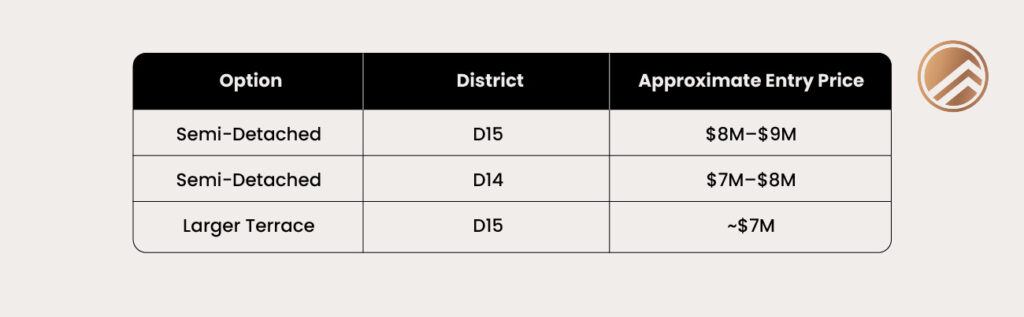
The terrace option in District 15 offers a strong address but may feel tight for a multi generational household.
The District 15 semi-detached option provides prestige but sits at the upper end of their budget.
The Final Choice
In the end, they choose a semi-detached home in District 14.
The reasoning is strategic rather than emotional.
District 14 often functions as a substitute market for District 15, offering many similar landed lifestyle advantages but at a lower price point.
For Andrew and Mei Ling, the slightly lower district premium translates into something valuable: more land and more interior space within the same budget.
They gain the layout flexibility required for multi generational living without stretching their finances unnecessarily.
In this case, the district hierarchy works in their favour.
Instead of paying the full District 15 premium, they capture similar lifestyle benefits at a slightly lower cost.
Scenario Three: The Legacy Buyer
Profile
Mr Tan is a business owner in his early fifties. Having recently sold part of his company, he is considering upgrading his family home into a long term legacy property.
His priorities differ from the previous two buyers:
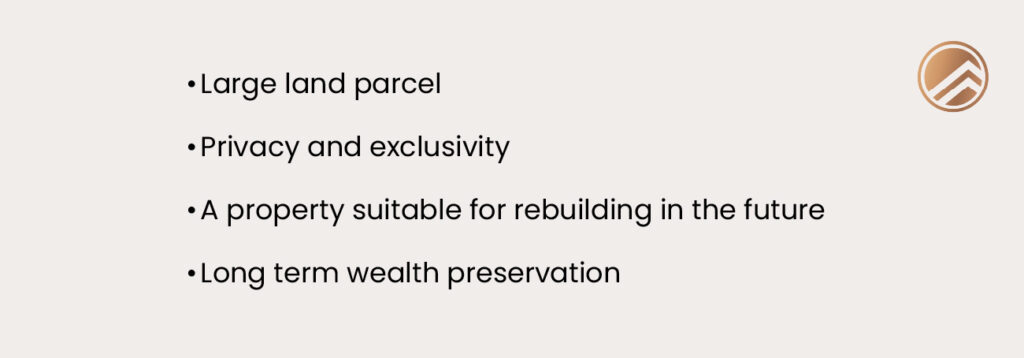
His budget sits between $15 million and $20 million, placing him squarely in the detached house segment.
Market Reality for Detached Homes
Detached homes represent the most bespoke segment of Singapore’s landed market.
Unlike terrace homes, where land sizes and layouts tend to be relatively standardised, detached houses vary widely in terms of:

As a result, transaction volume is much lower. In 2025, District 15 recorded only 33 detached home transactions, compared with far higher volumes for terraces.
Listings in this segment also cluster heavily within the $15 million to $20 million range, reflecting the ultra prime positioning of these properties.
Because the buyer pool is smaller, detached homes often require longer marketing periods and stronger differentiation to achieve successful transactions.
The Options He Considers
Mr Tan considers three possibilities:
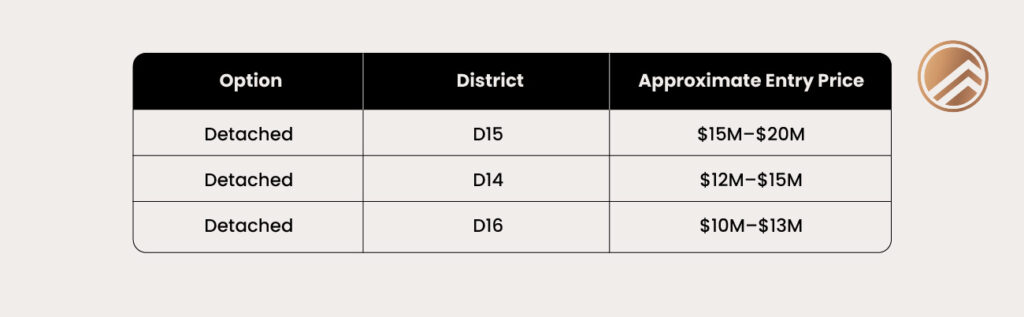
Each district offers a different value proposition.
District 16 offers the largest land sizes for the price. District 14 offers a balance between affordability and centrality. District 15 commands the strongest address prestige.
The Final Choice
Mr Tan ultimately chooses a detached home in District 15.
For buyers in this category, the decision often goes beyond purely financial considerations.
District 15’s sustained price leadership across landed segments reflects deep structural demand for the address.
For legacy buyers, this matters. They are not simply purchasing land. They are purchasing an address that retains prestige and desirability over decades.
In Mr Tan’s case, the premium paid today becomes part of a long term wealth preservation strategy.
What These Three Scenarios Reveal About the Market
When viewed together, these scenarios highlight an important truth about Singapore’s landed market.
There is rarely a single “best” property for everyone. Instead, different buyer profiles tend to gravitate toward different segments and districts.
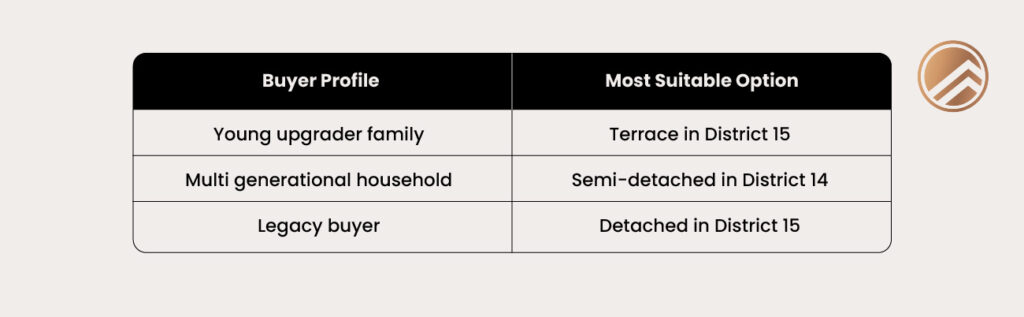
This pattern also reflects the broader positioning of the three eastern districts:
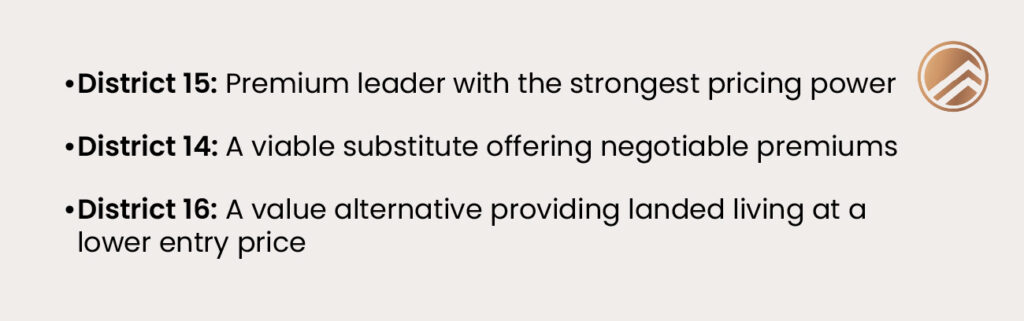
Each district therefore plays a different role within the landed market ecosystem.
Looking Ahead to 2026
While the overall trajectory of landed prices remains structurally upward, the next phase of the market may be shaped less by direction and more by speed of transaction.
Inventory clusters have emerged within several price bands:
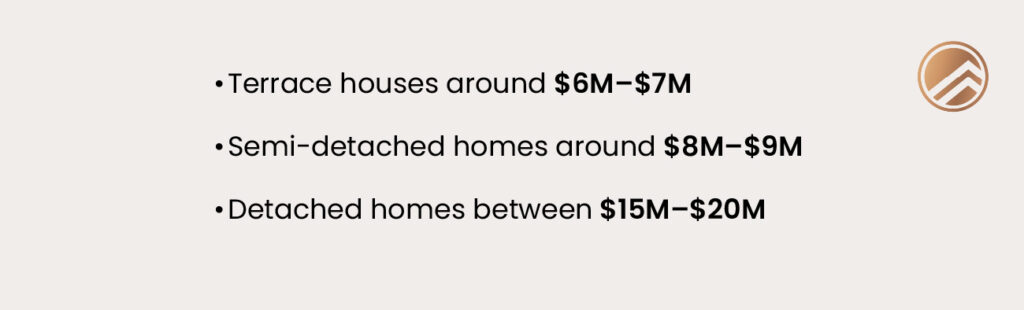
When inventory becomes concentrated within narrow price ranges, buyers naturally become more selective.
Properties that stand out through superior design, renovation quality or micro location tend to move faster. Those that do not may require longer marketing periods before finding the right buyer.
The Final Takeaway
Choosing a landed home is rarely just about picking the “best” district.
It is about understanding how your life stage, financial comfort and long term plans intersect with the realities of the market.
For some buyers, the prestige and lifestyle of District 15 justify the premium.
For others, District 14 provides a practical balance between space and cost.
And for those seeking the most affordable entry into landed living, District 16 continues to offer opportunities at lower price points.
In the end, the right landed home is not defined solely by the district.It is defined by how well it fits the life you are building within it.
If you are considering your next move within the East’s landed market, speak with our sales consultants to discuss how these market dynamics may apply to your specific home or buying goals.
Thank you for reading, and stay tuned! For more detailed insights regarding the landed property market, join our Landed VIP Club and stay updated with the latest market trends and expert advice.