
Most landed homeowners don’t actually want to “move away”. They simply want to “move up”.
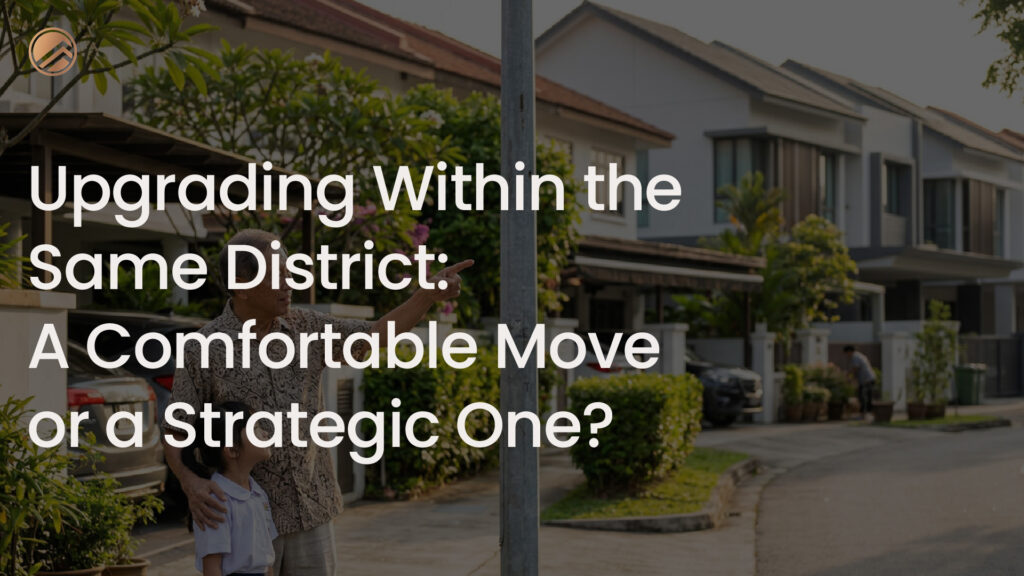
When the idea of upgrading comes into play, the instinctive decision for many is to stay within the same district. It feels logical. It feels safe. After all, you already understand the area, your daily routines are built around it, and in many cases, your family life is anchored there.
But while upgrading within the same district can be a sensible move, it is not always the most straightforward one. The real question is not whether you should stay or leave, but whether you are upgrading in the right way.
Why staying within the same district feels like the obvious choice
There is a reason this path resonates so strongly with landed homeowners. It solves for disruption.
Daily life does not need to change. The routes you take, the amenities you rely on, even the pace of the neighbourhood all remain familiar. For families, this continuity is often invaluable. Children stay close to their schools, and parents do not need to rework routines that have already been optimised over time.
There is also a deeper layer to this. Many landed enclaves are not just locations, but communities. Over time, neighbours become familiar faces, and the environment itself starts to feel like an extension of home. Moving out of the district can feel like giving that up.
On the surface, upgrading within the same district feels like a controlled step forward. You are not taking on the uncertainty of a completely new environment. You are simply improving your living situation within a space you already understand.
The hidden assumption behind staying put
However, this decision often comes with an unspoken assumption that staying within the same district naturally leads to a better upgrade.
This is not always true.
In reality, when you choose to upgrade within the same district, you are competing within a tighter and often more premium supply pool. The familiarity that makes the move feel comfortable is also what drives demand. And where demand concentrates, pricing follows.
As a result, many buyers end up paying a premium simply to remain within the same enclave. The upgrade becomes one of comfort and convenience, rather than one of value.
This does not make the decision wrong. But it does mean that the margin for error becomes smaller.
When upgrading within the same district makes sense
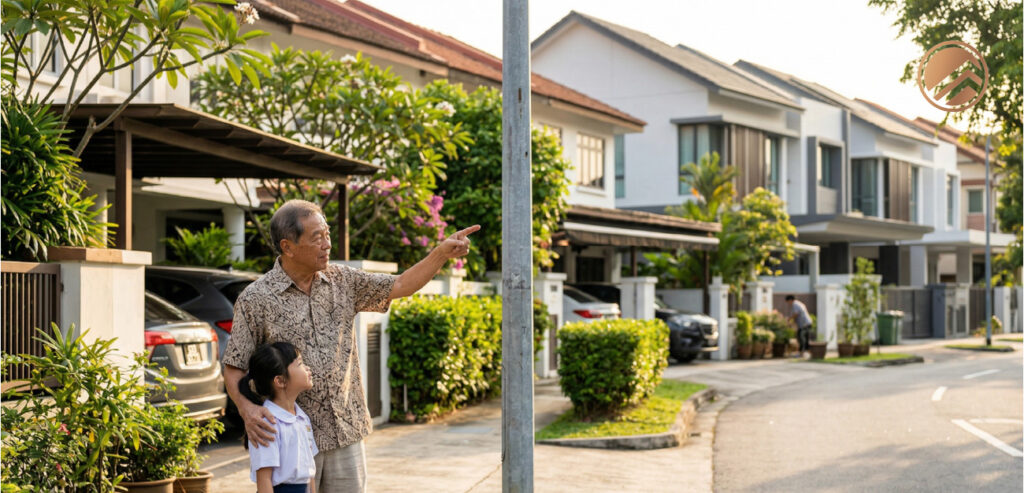
There are situations where staying within the same district is not just reasonable, but strategically sound.
If your priority is lifestyle continuity, then the premium you pay may be justified. For some families, stability carries more weight than extracting maximum value from the move. In these cases, the return is not purely financial, but also in the form of reduced disruption.
It also works in your favour if you have a strong understanding of the micro-market. Familiarity with the area can be an advantage if you know how to identify undervalued properties or spot opportunities that others might overlook. This is especially true in mature landed enclaves where nuances in street positioning, frontage, or plot characteristics can significantly affect value.
More importantly, staying within the same district makes sense when you are genuinely upgrading the land, not just the house. A better plot, a wider frontage, or improved redevelopment potential can justify the move even if you remain within the same location.
Timing matters as well. Entering the market at a point where prices are still supported by fundamentals, rather than inflated by short-term demand, can make a significant difference to your long-term positioning.
The most common mistake: overpaying for comfort
Where many buyers go wrong is confusing convenience with value.
In familiar districts, it is easy to gravitate towards homes that are already renovated or move in ready. These properties naturally command a premium because they reduce immediate hassle. However, this premium is often tied to built up condition rather than underlying land value.
Over time, this becomes a problem.
Built up condition depreciates. Renovations age. Layouts that feel ideal today may not remain practical in the long run. What remains constant is the land.
By paying a premium for a home’s condition, you may be locking in a higher entry price without a corresponding increase in long term upside. On top of that, many buyers underestimate the eventual cost of rebuilding or undertaking major additions and alterations. What initially feels like a finished home can still require significant capital expenditure down the line.
The result is a compressed margin. You enjoy the comfort today, but your flexibility in the future becomes limited.
Understanding the trade off you are making
Every property decision comes with trade offs, and staying within the same district is no different.
On one hand, you gain certainty. Your lifestyle remains intact, and you avoid the friction that comes with adapting to a new environment. On the other hand, you are likely entering at a higher price point, with fewer opportunities to arbitrage value across different districts.
If you were to move to a different district, especially one that is slightly less mature or less tightly held, you might find larger land plots or better value per square foot. The trade off, of course, is that you would need to rebuild your routines and adjust to a new setting.
Neither approach is inherently better. What matters is being clear about what you are prioritising — comfort or optimisation.
How to upgrade within the same district the right way

If you have decided that staying within the same district is the right move, the next step is ensuring that you execute it well.
The most important principle is to anchor your decision on land, not on the house. The condition of the property can be changed over time. The land cannot.
This means looking beyond properties that are immediately appealing. In many cases, the better opportunities lie in homes that are older, less polished, or require some level of reconfiguration. These properties tend to carry less of a premium, allowing you to enter at a more reasonable price while retaining the option to enhance the asset later.
At the same time, it is important to understand the natural price ceiling within your district. Every enclave has its limits, and buying too close to that ceiling reduces your room for future growth. Knowing where that ceiling lies helps you avoid overextending.
Planning for capital expenditure is equally critical. Whether it is a full rebuild or incremental additions and alterations, these costs should be factored in early. This ensures that your upgrade remains sustainable, rather than becoming a financial strain over time.
Finally, discipline is key. Familiar districts often come with emotional attachment, and it is easy to get drawn into competitive bidding situations. Staying objective and grounded in your valuation framework will help you avoid overpaying.
Why more buyers are choosing to stay within their district
In recent years, there has been a noticeable shift towards homeowners choosing to upgrade within their existing districts.
Part of this is driven by market conditions. With interest rates having moved through a rising cycle, buyers have become more cautious. The idea of making a large leap into an unfamiliar area feels riskier, especially when financial commitments are significant.
At the same time, the limited supply of landed homes in Singapore continues to reinforce the value of established enclaves. Once homeowners are anchored in a district they are comfortable with, the tendency is to remain within it rather than venture out.
There is also a growing emphasis on stability. For families, maintaining continuity in schooling, social environments, and daily routines has become an increasingly important consideration.
It is not about where you move, but how you upgrade
Upgrading within the same district is neither the safest choice nor the most aggressive one. It sits somewhere in between.
Done well, it allows you to improve your living situation while maintaining the lifestyle you value. Done poorly, it can result in overpaying for short term comfort at the expense of long term flexibility.
The key lies in clarity. Understanding what you are truly upgrading for, and ensuring that your decision aligns with that intention, makes all the difference.
Because in the end, it is not about whether you stay or move. It is about whether your next property places you in a stronger position than before, both as a home, and as an asset.
Have questions about your upgrade options? Reach out to our consultants for a clearer perspective.
Thank you for reading, and stay tuned! For more detailed insights regarding the landed property market, join our Landed VIP Club and stay updated with the latest market trends and expert advice.